Your Domain Name Is A Business Asset. Treat It Like One.
A domain name may look simple on the surface. It is the address people type into a browser, the name printed on business cards, and the link shared in search results, ads, emails, invoices, social profiles, and customer messages.
But behind that short web address is something much more important: control.
For small businesses, a domain name is not just a technical detail. It is a digital asset tied to brand identity, customer trust, email reliability, website access, and long-term visibility. Losing control of it can cause immediate damage. A website can go offline. Email can stop working. Customers can land somewhere else. A competitor, scammer, or unrelated buyer may gain leverage over a name the business has spent years building.
That is why domain management deserves more attention than it usually gets.
ICANN, the global nonprofit organization that coordinates the internet’s domain name system, says domain registrants have both rights and responsibilities, including responsibility for the registration and use of their domain name.¹ In plain English, that means business owners should know where their domain is registered, who has access to it, and what happens if something needs to be changed, renewed, transferred, or recovered.
For many companies, that information is blurrier than it should be.
The Domain Is Often Forgotten After Launch
A website launch usually gets plenty of attention. The design is reviewed. The logo is uploaded. Pages are written. Forms are tested. The homepage goes live.
The domain name, by comparison, is often treated as a box that was checked early in the process.
That can create problems later. Sometimes a domain is registered under an old employee’s email address. Sometimes a designer, developer, friend, or former vendor controls the account. Sometimes the business owner does not know the registrar login. Sometimes renewal notices go to an inbox no one checks anymore.
None of those issues matter until they suddenly matter very much.
If a domain expires, the business may face downtime, recovery fees, lost traffic, broken email, and possible loss of the name. Even when recovery is possible, the disruption can be painful.
A domain name should be managed like a business account, not like a forgotten receipt from 2017 that lives in a drawer with mystery cables.
Renewal Scams Still Target Business Owners
Domain-related scams have existed for years because they work. Business owners often receive official-looking letters, emails, or invoices warning that a domain is about to expire, that search visibility is at risk, or that action is needed immediately.
The Federal Trade Commission has brought enforcement actions involving deceptive domain name renewal notices and billing schemes that targeted businesses and nonprofits.² In one case, the FTC said thousands of small businesses and nonprofits were billed for bogus renewal fees.³
The lesson is still relevant. A domain renewal notice should always be checked carefully before payment.
Business owners should confirm that the sender is their actual registrar, review the domain name listed, check the renewal date inside the official registrar account, and avoid clicking payment links in suspicious emails. When in doubt, go directly to the registrar’s website instead of using links in a message.
Scammers depend on urgency. Good domain management slows the process down.
Ownership Details Matter
One of the most important domain questions is also one of the simplest: who actually owns and controls it?
A business should make sure the registrant information, account email, billing method, and recovery options are current. ICANN notes that domain registrants have rights to information from their registrar about registering, managing, transferring, renewing, and restoring domain registrations.⁴ That information is only useful if the right person can access it.
For businesses, the domain should generally be held in an account controlled by the company, not by an outside vendor’s personal account. Vendors can still be given access when needed, but ownership and recovery should remain with the business.
This is especially important during redesigns, ownership changes, staff turnover, agency changes, mergers, rebrands, or disputes. A domain name should never become a hostage situation because the wrong person holds the only login.
Security Starts At The Registrar Account
A domain registrar account deserves the same level of protection as email, banking, or hosting access.
A weak registrar password can create serious risk. If someone gains access, they may be able to change DNS records, redirect the website, interfere with email, unlock the domain, transfer it, or disrupt key services.
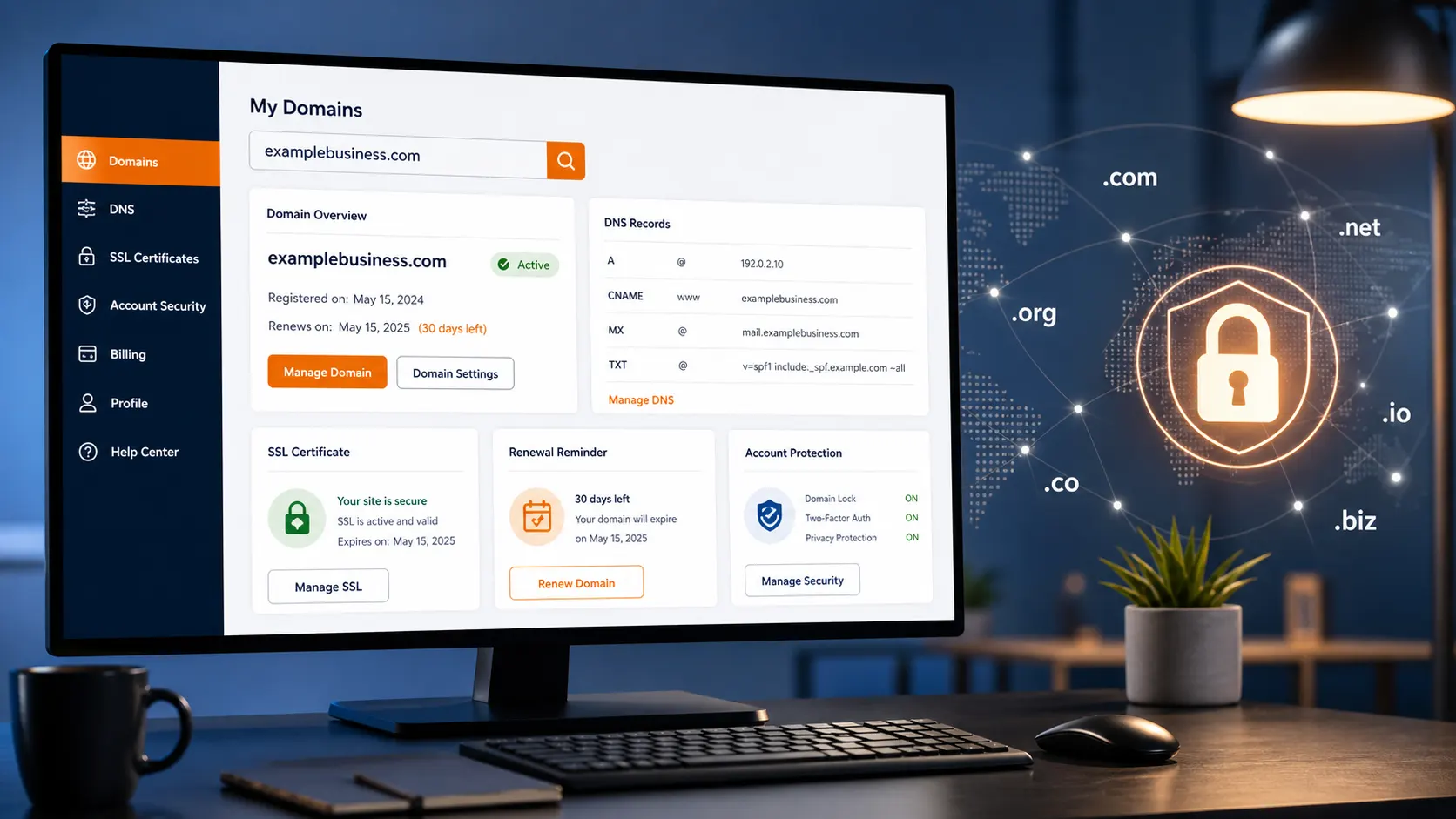
Basic protections should include a strong unique password, multi-factor authentication, updated recovery information, limited account access, and domain lock features when available. Businesses should also review who has permission to make changes.
Domain lock helps reduce the risk of unauthorized transfers. Multi-factor authentication helps protect the account if a password is stolen. Updated recovery details help prevent a simple access problem from turning into a business interruption.
These steps are not glamorous. They are also the kind of practical housekeeping that keeps a normal Tuesday from becoming a full-blown digital barn fire.
DNS Is Quiet Until It Breaks
DNS, or Domain Name System, is the technology that tells browsers, email systems, and other services where to find a domain’s website, mail servers, and related records. Most business owners never think about DNS unless something stops working.
That is understandable. DNS is not exactly dinner conversation unless the dinner party needs immediate evacuation.
Still, DNS matters because it controls how the domain connects to the rest of the internet. Incorrect DNS records can break a website, stop email delivery, disrupt verification with outside platforms, or interfere with security tools.
CISA describes Protective DNS as a service that helps detect and prevent access to known malicious domains, supporting broader cybersecurity risk reduction.⁵ While that specific federal service is aimed at eligible organizations, the broader point applies to all businesses: DNS is part of security infrastructure, not just a technical footnote.
Small businesses should know who manages their DNS, where the records are hosted, and whether those records are documented. That becomes especially important when changing hosting providers, moving email platforms, adding security services, or launching a new website.
HTTPS And Trust Go Together
Domain management also connects to website trust through HTTPS.
Google announced HTTPS as a ranking signal in 2014, noting that it was initially lightweight but part of a broader push toward secure, encrypted connections.⁶ Today, visitors also expect to see a secure connection when submitting forms, browsing service pages, or interacting with a business online.
An SSL certificate is what allows a website to use HTTPS. Many modern hosting plans include SSL support, but the domain still needs to be configured properly. If a certificate expires, is misconfigured, or does not match the domain, visitors may see browser warnings that can damage confidence.
A secure domain setup should make HTTPS normal, not optional.
Better Domain Management Is Not Complicated
Small businesses do not need to turn domain management into a full-time job. They do need a simple process.
The most important steps are practical:
Confirm the domain registrar.
Confirm who controls the account.
Use a company-owned email address.
Enable multi-factor authentication.
Turn on auto-renewal when appropriate.
Keep billing information current.
Document DNS records.
Limit access to trusted people.
Review renewal notices before paying.
Know how to recover the account.
That list may not be exciting, but it is much cheaper than trying to fix a lost, expired, hijacked, or misdirected domain.
Domain Names Are Important Assets
A domain name is one of the most important digital assets a business owns. It supports the website, email, brand recognition, search visibility, customer trust, and everyday operations.
Treating it as a minor technical detail is risky.
For small businesses, better domain management means knowing who owns the domain, where it is registered, how it renews, who can access it, how DNS is managed, and what protections are in place.
A good domain name helps customers find a business. Good domain management helps make sure they can keep finding it.
Sources
¹ ICANN, Registrants’ Benefits and Responsibilities
https://www.icann.org/resources/pages/benefits-2013-09-16-en
Source reference:
² Federal Trade Commission, Network Solutions Settles FTC Charges
https://www.ftc.gov/news-events/news/press-releases/2003/09/network-solutions-settles-ftc-charges
Source reference:
³ Federal Trade Commission, FTC Halts Cross Border Domain Name Registration Scam
https://www.ftc.gov/news-events/news/press-releases/2010/08/ftc-halts-cross-border-domain-name-registration-scam
Source reference:
⁴ ICANN, Information for Domain Name Registrants
https://www.icann.org/registrants
Source reference:
⁵ Cybersecurity and Infrastructure Security Agency, Protective Domain Name System Resolver
https://www.cisa.gov/resources-tools/services/protective-domain-name-system-dns-resolver
Source reference:
⁶ Google Search Central Blog, HTTPS as a Ranking Signal
https://developers.google.com/search/blog/2014/08/https-as-ranking-signal
Source reference:
About the Author
J.R. Murphy is a technology writer focused on web hosting, domains, website security, and the digital tools that help businesses build a stronger online presence. His work is written for business owners, website managers, and everyday users who need clear, practical information without unnecessary technical noise.
With a focus on hosting infrastructure, uptime, cybersecurity, backups, domain management, business email, and website performance, J.R. helps readers understand how the systems behind a website affect real-world results. His articles often explore the connection between reliable hosting and customer trust, search visibility, online safety, and long-term business growth.
J.R. brings a research-driven approach to every topic, using credible sources and plain-language reporting to explain what matters, why it matters, and what business owners should look for when making digital decisions. His goal is to make web technology easier to understand, easier to manage, and more useful for organizations of all sizes.
Through his writing, J.R. Murphy helps readers move beyond surface-level website decisions and take a smarter approach to the infrastructure that supports their brand, their customers, and their online future.
Recent News & Insights
Keep up with useful articles, straightforward guidance, and professional insight on websites, hosting, domains, security, and online business tools. Our news section helps you understand your choices, make better decisions, and manage your website with greater confidence.


Looking For Something Else?
Discover additional services and solutions to support your website, with straightforward pricing and flexible options that make it easy to find the right fit.
Shared Hosting
Shared hosting is a great fit for smaller websites that don’t require dedicated resources.
VPS Hosting
More power and control with dedicated resources for growing websites and applications.
Domain Names
Search, register, and manage domain names with simple pricing and easy setup.
Website Solutions
Get help building, managing, or improving your website with practical solutions.
Ready to Build with Confidence
From hosting and domains to technical support and website solutions, we help businesses choose reliable services built for performance, stability, and long-term growth.

Reliable hosting, domain services, and technical solutions designed to support websites, servers, and growing businesses with confidence.
- Hobe Sound, FL
- support@fosservicesllc.com
Websites
Hosting
© 2026 FOS Services LLC. All Rights Reserved